Showing posts with label Etosha. Show all posts
Doing a Nature Oriented Tour of Namibia
Some time back I wrote a blog post called Ten Reasons to Visit Namibia. The post has been one of my most read posts, and I still get a visitor or two there till now. I have also found that I spend a lot of time dispensing advice to people who write to me directly or through social media, such as Twitter. Over the last few weeks my wife and I have been working on using Frantic Naturalist to set up a web based booking office. We are still working on the details of that and I'll tell you more about it in the coming days. But the basic idea is to create an information platform to sell various things such as activity bookings, hotel and lodge bookings and so on through it.
As a result of building the website, I have been doing a lot of reading and talking about Namibia, it's various bits and pieces, the tourist routes, stuff like that. Namibia really is a wonderful country. I have been so fortunate to have seen more of the country than most Namibians would ever have the chance to do.
I am guessing that I can assume with some confidence that if you are reading this blog you have some clue as to where Namibia is (if not, I'm sorry...look it up).
I'll also assume you enjoy nature...since you are reading a blog called Frantic Naturalist.
So, just for fun, here is a mock-up Namibia tour itinerary for the Nature Enthusiast. I'll be sort of vague where I can, so that this can be used for either a top end trip, or more middle budget. I don't think it will fit to well for a cheap trip, but with a bit of help, it could be done fairly cheap.
Day 1. Land in Windhoek, travel in to town, stay (I would recommend a guest house over a hotel). If you have the energy, go out to Avis dam for a walk around. You may be interested in the botanical gardens, though they are not that interesting. Sleep well...lots of travel to come.
Day 2. Travel to eastern Etosha. If it is the dry time, basically you just want to get this done with. It's a really long drive. You could even fly it, and get a guide to meet you at a lodge east of Etosha or perhaps even organise delivery of a hire vehicle there?
If you are a birder, doing this now (rainy season - Feb, March, April sort of time) slow that first day down just enough to spend time stopping for raptors.
With good timing you could do a drive in Etosha.
Day 3 (and maybe even day four) spend doing drives in the eastern part of Etosha. I could (and probably will elsewhere) write a great deal about how to do game drives in Etosha if you are there self drive. The basic plan usually is something like:
Cover ground early in the morning, both at waterholes and away. This is the time to see a lot more of the exotic things, including cats and rhinos, that you are not likely to see later on.
Once it gets hotter and animals are slowing down, make a deliberate effort to change your approach. I think it is a good idea to go for a toilet stop at Namutoni. Then head out, but this time plan to head to waterholes and no longer aim for the exotic things. Now spend time watching whatever is there. Zebra, Springbok, Ostrich, Giraffe, Kudu, Guinefowl, Tawny Eagle, Parrots, the terrapins in the water trying to take Red-billed Quelea...basically, get the mad rush out of your head and take time to REALLY enjoy, experience, absorb the experience.
When you feel a bit sleepy/hot, head back to camp, have some brunch, take a walk around the lodge grounds/campsite. I like a place like Kempinski Mokuti Lodge for that. It is not a typical game lodge...more sort of resort/hotel...ish, but because of that there are huge grounds that you can walk around in. By mid morning there are actually lots of birds around...look for water spots. If you are at Mokuti, go to the snake/reptile park. It isn't the best (not much in the way of small stuff) but it's grounds are good for birds too.
Take some time to relax and head out for the afternoon. My afternoon plan always depended on two things, 1. What we had already seen (and what my guests still wanted to see), 2. What I had found out earlier in the day. As a guide, Etosha is always fun because you have a huge number of people who can give you an idea of whats happening where in the park.
But, usually you will want to plan your afternoon around doing about three waterholes, saving the best for last. I would say, without any knowledge of something at another waterhole, you should end with Chudop. Leave enough time for the gate - don't make a mad rush for it...trust me, you don't want to run into an Elephant...not good for health or insurance.
Day 5(ish) - the 'cross the park' day. Trust me, this day is tiring. Driving 160 km is very easy. Doing a game drive is a whole different story. So, what you want to do is do it just like any other day. Get up early and spend time looking for cool stuff while making good progress for the first hour or so. Then slow it down at the waterholes as it warms up. Then take a good break for lunch at Halali. I advise a rest there, and a swim just before you head back out to cool yourself down (remember to keep your swimming stuff handy). You could even spend a night in Halali. Sometimes the grounds staff can find owls for you...ask the security guards. And give them something for their efforts.
Mid afternoon head through to Okaukuejo for the remainder of the cross park journey. Usually this bit feels especially long. I advice just doing it straight, especially if you have a couple days on that side of the park to do all the loops and waterholes.
Once you get back into camp settle in and relax a bit. Unless it is rainy season, you want to really spend a good amount of time at the waterholes at night.
Your days here would be much like I explained for the other side of the park except that you really want to spend a lot of time at the waterhole at night, so give yourself plenty of time to rest in the day.
Day 7 or so: Heading out from Etosha, you could go a number of places, most of which are far to the west. I would suggest going to Etendeka Mountain Camp. It is a very simple, small camp on a huge area getting into the drier regions. Etendeka (and the nearby Palmwag area) is unique. One of the reasons for doing Etosha first is to get the 'mega-fauna' stuff out of the way, but the Etendeka area still has a good bit of wildlife, especially considering how dry the area is. Here you could find things like the Desert Elephants, Black Rhino, Giraffe, Cheetah, Leopard, Lions and Hyena. But you may not see any of these in a visit to the region. It is the setting, more than anything, that is just so amazing. Etendeka is set in a massive 1km thick layering of Basalt. The lava had actually flowed enough to make the volcanic rock appear to be sedimentary. It is a dark red landscape. It is one of those places that a person in a rush comes to and sort of thinks "Why did I come here" for one afternoon, and then over the next day you settle in, your mind slows down, and you find, actually, that visiting that place is the reason you came to Namibia in the first place.
Let me emphasise it, because in my experience, it is important. I learned so much of this stuff from the couple hundred travel agents I have had the pleasure of driving around in Namibia. I can probably write an interesting book about travel agent psychology, but one of the main thing is the percentage of them (lets say 30%...I think 60 or perhaps its 99%) who have the 'checklist' mentality.
It is not their fault. Most of these people don't own the company they work for. They are on educational trips and are told "Find out why people should go to ....". They come to make lists.
Etendeka isn't good for lists. But it is good for visitors for exactly that reason. It is simple. No decoration. Simple tents. Simple canvas structure main lapa. Some of the food is cooked on an open fire or in a solar oven. Water is budgeted. Have you ever taken a bucket shower? Visit Etendeka, it's special.
With enough time, you could head north from there and visit some of the more remote parts of Namibia. That is the area where you find the Himba people. You'll probably want to travel there with some of the tour operators who know the area well.
Day...after leaving Etendeka: Okay, back on my tour, we are heading back to the Twyfelfontein area, to the south of Etendeka. It isn't a long drive, so you can take it easy. In the evening perhaps do a drive with the lodge you are staying at. If you are interested in Geology, the area has some interesting sites...well documented elsewhere, so I am not going to go into detail here.
You could stay at Mowani Lodge if you are looking for a nice place. Stay one night, and, after packing up, get going early for the walk at Twyfelfontein in the morning. Then you want to make your way down to the coast.
Swakopmund and the coast is strange and foggy, but there is a lot of stuff to do. There are a whole range of adventure activities, there are some nice shops for those who are interested in stuff like that. But for the nature enthusiast, there really are lots of things to do. I would suggest going down to Sandwich Harbor, which I wrote about before.
You could also do a boat trip. Perhaps go with Mola Mola...I can't really advise at this time which is the best company.
I would stay at the Beach Lodge if you have transport. It is a little out of the center of town. Not that town is really busy, but when you have been out in the bush, it's just nice to still keep out of the center of town.
You could spend a two or even three nights in Swakopmund with ease.
Last leg: Head down to Sesriem and Sossusvlei. If you can afford it, stay on NamibRand Nature Reserve, where three nights would be very worth while. At some of the more simple places, perhaps two nights are better. I have written about Sossusvlei a few times - here is one Sossusvlei post, and you can search for others.
From there, head back to Windhoek for your trip out.
This is somewhat of a standard route, but would be a great trip. Share this post
Digg Stumble Technorati Facebook Reddit Subscribe
Photographic Tour of Namibia
About a year ago an old collage friend of mine, Shem Compion, asked me if I would be interested in helping him out on a tour. Of course, I said I would.
Shem is an accomplished photographer and runs a tour company taking exclusive photographic safaris called C4Images.
I picked up Shem in Windhoek and we began organizing our tour, all the while chatting about what we had been up to in the last 10 years. After getting our tour vehicles we went out to the Airport and picked up the guests. They slept in Windhoek that night.
The next morning we set off for Sossusvlei. We stayed at Sossus Dune Lodge, run by Namibian Wildlife Services. There website has been down for some time but just to be fair to them, here is the link. The lodge was built really nice but management very poorly. However, it sports one overwhelming advantage...it's in the park. For photographers that's a big advantage as we could literally be in or out of the park any time we chose.
We took full advantage of our time there, with three nights we did many trips down the Sossusvlei Valley each time picking different spots to explore and photograph.
I really love Sossusvlei, and it was just a pleasure to spend the time there. I am certainly not a hotshot photographer, but with all the time one has on a photographic tour, even the guides have lots of time to take pictures. I took full advantage and really learned a lot from the guests, from Shem and from the tour leader of the group who was from Hosking Tours.
Despite having some guests who were not that young anymore, we did a fair bit of walking in to locations, which gives you the advantage of capturing and experiencing the more pristine areas. It also means that, because vehicles are not allowed there, they stay pristine after you have gone.
We had rather windy conditions at Sossusvlei, but because these winds warmed the area up, we got to see various animals we otherwise wouldn't, including a couple Barking Geckos...Small little ground dwelling geckos you normally only hear, but struggle to see.
After Sossusvlei we left for Erongo Wilderness Lodge. It was a long drive getting there, but we made it with some good light to spare. The guests didn't waste a second...they started taking pictures right as we got there.
Erongo Wilderness Lodge is a bit like The Flintstones in Luxury. The lodge is set in a hilly area near the Erongo mountains. The area is made up of huge Granite bolders and outcrops. It is a really beautiful place.
Being a keen birder, the area is rather special to me for all its specials. Perhaps the most special is the Hartlaub's Francolin, which I didn't manage to see on this trip. I did have some luck with Rockrunners, and got a few pictures.
Rockrunners can be rather hard to get hold of because of their habit of running between the rocks and not doing much flying. In the years where the rain was good this can make it really tricky, but this individual gave me a few tries. I don't have such a long lens, and so it's not very sharp, but it was sitting so nicely in good light.
This image is posted on my flickr account.
We had a really long day, with an 11 hour game drive, but it was certainly worth it, considering the experience we had.
The next day we took it easier and arranged a trip to visit a Himba village.
Himba people still live a nomadic pastoral way of life in North-western Namibia. Since Namibia's independence the Himba have become a very popular part of the tourism circuit in Namibia. If you plan to visit the Himba people, please be sure to visit them with a local guide, and be sensitive to them...you are visiting people in their own homes.
After our stay at Sesfontein we moved on to Etosha. Etosha is just plain fantastic! I have never been through Etosha without a feeling that my stay was to short!
Our first to nights in the park were at Okaukuejo. Okaukuejo is the rest-camp within the park in the center. There are a further two rest-camps further east, namely Halali and Namutoni.
Okaukuejo is famous for it's waterhole. It is floodlit at night and both night and day the waterhole is interesting to watch.
A bunch of Elephants drink at Okaukuejo in the image. Elephants can be found both day and night at the waterhole. At night the highlight is frequent visits by Black Rhino. Etosha supports one of the biggest populations of Black Rhino.
Our full day at Okaukuejo was simply spent watching the waterhole. I ran around birding and trying to find birds for the guests to photograph. They got great images of Pygmy Falcons, that gave us great opportunities to really study them and compose great pictures. My lens was a little to short for great pics, but I had a go non the less.
From Okaukuejo we made our way accross the park. We stopped at Halali where we had a lunch stop and found some Owls to photograph with the help of the staff at Halali Rest-camp.
The tiny African Scops-owl is always fun to photograph. This image has been uploaded to The Internet Bird Collection website.
After lunch the game drive vehicles from Mushara Lodge came out to Halali as a special favor so that the guests could do the afternoon in open vehicles...better for photography than our mini vans.
Our last two night of the trip were spent at Mushara. We spent the full day doing game drives on the Eastern side of the park. We moved at a slow pace and spent a lot of time with any game we found, regardless of weather they were lions or springbok. It was a great way to finish off the trip.
The very last waterhole we visited was certainly one of the highlights of the whole tour, with over 50 elephants on a single waterhole in great afternoon light!
The next day was an early morning, long drive back to Windhoek for the guests flight home. It certainly could have been my favorite trip ever.
I would like to add a special thanks to Shem Compion from C4Images for using me to help on the trip, and to Martin Withers, the group leader from Hoskings Tours and a master wildlife/nature photographer. Of course, I would also like to thank the guests if any of them ever see this blog post. It was fantastic.
Share this post
Digg Stumble Technorati Facebook Reddit Subscribe
Shem is an accomplished photographer and runs a tour company taking exclusive photographic safaris called C4Images.
I picked up Shem in Windhoek and we began organizing our tour, all the while chatting about what we had been up to in the last 10 years. After getting our tour vehicles we went out to the Airport and picked up the guests. They slept in Windhoek that night.
The next morning we set off for Sossusvlei. We stayed at Sossus Dune Lodge, run by Namibian Wildlife Services. There website has been down for some time but just to be fair to them, here is the link. The lodge was built really nice but management very poorly. However, it sports one overwhelming advantage...it's in the park. For photographers that's a big advantage as we could literally be in or out of the park any time we chose.
We took full advantage of our time there, with three nights we did many trips down the Sossusvlei Valley each time picking different spots to explore and photograph.
I really love Sossusvlei, and it was just a pleasure to spend the time there. I am certainly not a hotshot photographer, but with all the time one has on a photographic tour, even the guides have lots of time to take pictures. I took full advantage and really learned a lot from the guests, from Shem and from the tour leader of the group who was from Hosking Tours.Despite having some guests who were not that young anymore, we did a fair bit of walking in to locations, which gives you the advantage of capturing and experiencing the more pristine areas. It also means that, because vehicles are not allowed there, they stay pristine after you have gone.
We had rather windy conditions at Sossusvlei, but because these winds warmed the area up, we got to see various animals we otherwise wouldn't, including a couple Barking Geckos...Small little ground dwelling geckos you normally only hear, but struggle to see.
After Sossusvlei we left for Erongo Wilderness Lodge. It was a long drive getting there, but we made it with some good light to spare. The guests didn't waste a second...they started taking pictures right as we got there.
Erongo Wilderness Lodge is a bit like The Flintstones in Luxury. The lodge is set in a hilly area near the Erongo mountains. The area is made up of huge Granite bolders and outcrops. It is a really beautiful place.
Being a keen birder, the area is rather special to me for all its specials. Perhaps the most special is the Hartlaub's Francolin, which I didn't manage to see on this trip. I did have some luck with Rockrunners, and got a few pictures.
Rockrunners can be rather hard to get hold of because of their habit of running between the rocks and not doing much flying. In the years where the rain was good this can make it really tricky, but this individual gave me a few tries. I don't have such a long lens, and so it's not very sharp, but it was sitting so nicely in good light.We also had fun taking pictures around the lodge in the morning, especially the huge numbers of the beautiful Rosy-faced Lovebirds.
We only spent one night there and had a big drive again the next day. We stopped at Twyfelfontein area around lunch time and visited the famous rock art site, now Namibia's only World Heritage Site. It is certainly advisable to try to do the Twyfelfontein walk in the early morning or late afternoon if possible. And it's lots of ups and downs.
From there it was on to Sesfontein. We stayed at Fort Sesfontein Lodge, which is a bit of a poor lodge, but gives access to an amazing area. We were there three nights.
Our first full day was a trip down the Huanib River. Our main interest was to capture images of the Desert Elephants. The springs in the riverbed on the eastern side had lots of water and we were hopeful of a great day. We saw lion tracks along with many others. We found some interesting birds, including a female Painted Snipe...rather special for the area.
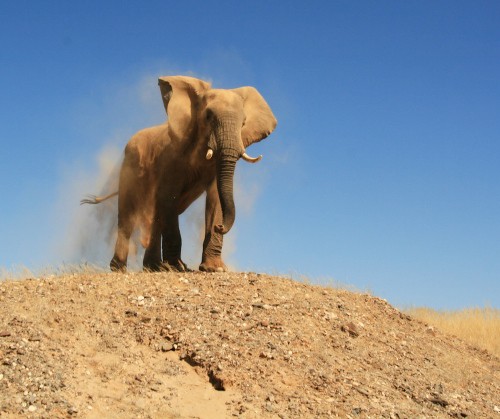
Around eleven o'clock we found our first Elephants. From there we had a few good elephant encounters. We spent some time watching each group we found, being careful, of course, not to be intrusive, but to let the images come from the animals naturally. Despite this, my best image of the day was of an elephant gave us a little display, shaking his dust (after dust bathing) into the air above us as we moved away from him into the riverbed.
This image is posted on my flickr account.
We had a really long day, with an 11 hour game drive, but it was certainly worth it, considering the experience we had.
The next day we took it easier and arranged a trip to visit a Himba village.
Himba people still live a nomadic pastoral way of life in North-western Namibia. Since Namibia's independence the Himba have become a very popular part of the tourism circuit in Namibia. If you plan to visit the Himba people, please be sure to visit them with a local guide, and be sensitive to them...you are visiting people in their own homes.
After our stay at Sesfontein we moved on to Etosha. Etosha is just plain fantastic! I have never been through Etosha without a feeling that my stay was to short!
Our first to nights in the park were at Okaukuejo. Okaukuejo is the rest-camp within the park in the center. There are a further two rest-camps further east, namely Halali and Namutoni.
Okaukuejo is famous for it's waterhole. It is floodlit at night and both night and day the waterhole is interesting to watch.
A bunch of Elephants drink at Okaukuejo in the image. Elephants can be found both day and night at the waterhole. At night the highlight is frequent visits by Black Rhino. Etosha supports one of the biggest populations of Black Rhino.
Our full day at Okaukuejo was simply spent watching the waterhole. I ran around birding and trying to find birds for the guests to photograph. They got great images of Pygmy Falcons, that gave us great opportunities to really study them and compose great pictures. My lens was a little to short for great pics, but I had a go non the less.
From Okaukuejo we made our way accross the park. We stopped at Halali where we had a lunch stop and found some Owls to photograph with the help of the staff at Halali Rest-camp.
The tiny African Scops-owl is always fun to photograph. This image has been uploaded to The Internet Bird Collection website.
After lunch the game drive vehicles from Mushara Lodge came out to Halali as a special favor so that the guests could do the afternoon in open vehicles...better for photography than our mini vans.
Our last two night of the trip were spent at Mushara. We spent the full day doing game drives on the Eastern side of the park. We moved at a slow pace and spent a lot of time with any game we found, regardless of weather they were lions or springbok. It was a great way to finish off the trip.
The very last waterhole we visited was certainly one of the highlights of the whole tour, with over 50 elephants on a single waterhole in great afternoon light!
The next day was an early morning, long drive back to Windhoek for the guests flight home. It certainly could have been my favorite trip ever.
I would like to add a special thanks to Shem Compion from C4Images for using me to help on the trip, and to Martin Withers, the group leader from Hoskings Tours and a master wildlife/nature photographer. Of course, I would also like to thank the guests if any of them ever see this blog post. It was fantastic.
Share this post
Digg Stumble Technorati Facebook Reddit Subscribe
Labels:
Etosha,
Photography,
Sossusvlei
Etosha
My recent trip and some travel advice for Etosha
The first morning we managed to see a couple Elephant bulls along with lots of plains game. No lions of the first day. Due to the huge rains that Namibia had had this year, there was a lot of water in the pans and so wildlife was really spread out. It really is my favorite time to go to Etosha, because you never know what you will find where, and the birding gets good. But to take people on their first Safari at a time like that is difficult. The truth of tour guiding is that no matter what your guests say, there is this unwritten (or is it written??) rule that says you MUST FIND LIONS.
The trip wasn't about Etosha at all, and we only did morning drives. The afternoons they would sleep, and then most of the night was spent with the telescope, preparing for the night when the occultation of Pluto would occur.
We has some nice drives and saw nice birds, including a couple sightings of Blue Cranes and an African Spoonbill. It was fun.
On our last day the worry was far more about weather. The whole thing (the occultation) boils down to a couple of minutes of critical, when the star passes behind Pluto. If clouds got in the way then, it would be all for nothing.
We did a last game drive on our final morning. It was rather quiet. It's always a tricky one. We had spent all our time on the same side of the park, and so you run out of new places to try. The guests were enjoying it a lot, so I wasn't to stressed. On our way out we decided to revisit one waterhole, and finally got a few lions lying near the road under some bushes. There was a man and female that probably had just finished a spree of mating as well as a couple males lying a little way off from the pair.
It was a nice ending to our game drives, but we still had weather to worry about. They had traveled half way around the world just to see this event, and these types of events don't happen that often. So there was a lot of pressure and not much we could do about it.
The afternoon rolled around and the weather looked fine. No problem. I was relaxing. The astronomers probably less so. But the sky was clear.
Then as the evening started coming in, a little cloud was lifting in the north. As the evening carried on, the cloud built and built. It was going to be a race. Marc, one of the astronomers had his camera taking short time laps photographs of the sky at short intervals, giving an interesting account of the night's weather.
It was getting stressful. I left to go to bed as I had the drive to Windhoek the next day. I slept a while, then woke up worried about the weather. I went out again and just waited until the actual event started. They were in luck, just a little window of clear sky showed in the region of Pluto and the occultation!
I didn't realize how close it had been until we watched Marc's pictures of the evenings sky the next day. It was amazing. This cloud just closed right in, just leaving that spot open. Just after the event they wanted one last go at taking some data, and when they tried, they got nothing...the clouds had closed in. It was amazing, the really just squeezed it in!
It was a wonderful trip and the type of thing that I would love to do in the future again. It was especially nice to have done it at Etosha, a place that has been special to me for years.
At a little over 22 000 square kilometers, Etosha is a big place! The park is rather diverse, with a huge salt pan taking up a good part of the park, a variety of Broadleaved, Mopani, and Acacia woodland, grassy and dwarf shrub plains and saline pans. The park is mostly flat. Very flat. A few places, like Halali, have isolated hills around them. The park only really gets hilly on the far western side.
Despite it's size, Etosha has only a relatively small area open to the public. Don't let that worry you to much, as it's still a really big area, and you can spend many days in Etosha and still not see it all. It also means that the long drive from the east to west (or visa versa) should be taken as a whole day...more on that later.
There are lodges on the western side of the park, but the access through there is restricted to tour operators only and only really worth it if you are also traveling to the far north-west of Namibia. For game viewing the main area is perfectly fine.
For more information and bookings visit the Cardboard Box website. They are an excellent resource for traveling to Namibia, not just for information but for bookings, tours and even advice on things like insurance and safety.
That said, the other side of it is that doing a game drive on your own is magic. It's special. I love doing game drives with my family not so much for what we see, but just for being out there. Of course, if you haven't done game drives that much, what you see in important, but the experience itself is still magic.
In Etosha it's all about water. It can be a little bit boring in a way, though, to just cruse waterhole to waterhole. But in the dry season, most of the animals move to waterholes. In the rainy season this changes and you really don't know what you will see where. If you plan to visit Etosha in the rainy season (especially January to April) it is best to focus as much on birds and behavior as trying to find the high profile animals. Late dry season is the best for finding animals at the waterholes (September/October or even early November if the rains haven't broken.)
Look everywhere. Often people miss a rhino that is just in the bush a little from the road. Make sure you look into the bush.
Use the EARLY mornings. Your first hour is the best time to see Rhinos or Lions at the waterholes. Later, as the day warms up, you may see streams of wildlife at waterholes with up to five or six species of larger mammals present at the same time. Elephants basically drink any time. Giraffes often like to drink in the late afternoon, and it is really cool to watch that.
Always make sure you plan your time well in Etosha. Try to look in the sightings books to find out where interesting animals have been seen. Figure out your time to drive between places and add plenty of buffer. Don't speed in the park. It's bad for wildlife, and it's bad for those who planned better.
Google Earth is always interesting to look at, both before and after your visit to Namibia.
Bring a good camera. Small compact cameras are nice to carry, but make sure that you have a decent zoom. Anything less than a 300 makes taking wildlife photos hard.
Binoculars really make the experience so much better and if you can afford it, I recommenced a really good pair. I use Swarovski 10 x 42 binoculars (At AmazonSwarovski EL Binocular 10x42
)
and love them, but any of the good brands produce amazing binoculars, including Carl Zeiss, Leica, Nikon and of course Swarovski. Of course top range optics may be out of the question for you. I would still emphasizes getting a good pair. Don't get the compacts for Etosha. You want binoculars that you can see in poor light, especially if you are spending time at the waterholes at night.
It's nice to have a good field guide for mammals while you do game drives. I use "The Field Guide to Mammals of Southern Africa" by Chris and Tilde Stuart, published by Struik
If you are into birds, then Sasols birds of southern Africa is good.
You will find these books in most book stores. In Etosha you can by the parks map with a lot of the wildlife and birds on it.
Well, I think that's enough to get one started. Any questions, please shout. I know that a couple of the blog's regular readers know a bit about Etosha and I may have missed stuff. Please feel free to add or even make corrections in the comments. Share this post
Digg Stumble Technorati Facebook Reddit Subscribe
My recent Etosha trip
A couple weeks ago I had the great pleasure of taking two astronomers up to Etosha. The goal was for them to record (photograph) an occultation of Pluto. We spent four nights there and had the chance to do a few morning game drives in Etosha.The first morning we managed to see a couple Elephant bulls along with lots of plains game. No lions of the first day. Due to the huge rains that Namibia had had this year, there was a lot of water in the pans and so wildlife was really spread out. It really is my favorite time to go to Etosha, because you never know what you will find where, and the birding gets good. But to take people on their first Safari at a time like that is difficult. The truth of tour guiding is that no matter what your guests say, there is this unwritten (or is it written??) rule that says you MUST FIND LIONS.
The trip wasn't about Etosha at all, and we only did morning drives. The afternoons they would sleep, and then most of the night was spent with the telescope, preparing for the night when the occultation of Pluto would occur.
We has some nice drives and saw nice birds, including a couple sightings of Blue Cranes and an African Spoonbill. It was fun.
On our last day the worry was far more about weather. The whole thing (the occultation) boils down to a couple of minutes of critical, when the star passes behind Pluto. If clouds got in the way then, it would be all for nothing.
We did a last game drive on our final morning. It was rather quiet. It's always a tricky one. We had spent all our time on the same side of the park, and so you run out of new places to try. The guests were enjoying it a lot, so I wasn't to stressed. On our way out we decided to revisit one waterhole, and finally got a few lions lying near the road under some bushes. There was a man and female that probably had just finished a spree of mating as well as a couple males lying a little way off from the pair.
It was a nice ending to our game drives, but we still had weather to worry about. They had traveled half way around the world just to see this event, and these types of events don't happen that often. So there was a lot of pressure and not much we could do about it.
The afternoon rolled around and the weather looked fine. No problem. I was relaxing. The astronomers probably less so. But the sky was clear.
Then as the evening started coming in, a little cloud was lifting in the north. As the evening carried on, the cloud built and built. It was going to be a race. Marc, one of the astronomers had his camera taking short time laps photographs of the sky at short intervals, giving an interesting account of the night's weather.
It was getting stressful. I left to go to bed as I had the drive to Windhoek the next day. I slept a while, then woke up worried about the weather. I went out again and just waited until the actual event started. They were in luck, just a little window of clear sky showed in the region of Pluto and the occultation!
I didn't realize how close it had been until we watched Marc's pictures of the evenings sky the next day. It was amazing. This cloud just closed right in, just leaving that spot open. Just after the event they wanted one last go at taking some data, and when they tried, they got nothing...the clouds had closed in. It was amazing, the really just squeezed it in!
It was a wonderful trip and the type of thing that I would love to do in the future again. It was especially nice to have done it at Etosha, a place that has been special to me for years.
Advice for travelers to Etosha
I was asked (by Mary Winstone) for some travel advice for Etosha, which is something I have wanted to do for some time. So here goes.
General Information
Etosha is Namibia's premier wildlife or Safari destination. The park is just a little over a hundred years old. Etosha is managed by Namibia's Ministry of Environment and Tourism and the restcamps in the park are run by Namibia Wildlife Resorts, and organization tied to the parks.At a little over 22 000 square kilometers, Etosha is a big place! The park is rather diverse, with a huge salt pan taking up a good part of the park, a variety of Broadleaved, Mopani, and Acacia woodland, grassy and dwarf shrub plains and saline pans. The park is mostly flat. Very flat. A few places, like Halali, have isolated hills around them. The park only really gets hilly on the far western side.
Despite it's size, Etosha has only a relatively small area open to the public. Don't let that worry you to much, as it's still a really big area, and you can spend many days in Etosha and still not see it all. It also means that the long drive from the east to west (or visa versa) should be taken as a whole day...more on that later.
Accomodation
Where should you stay? That really is a question of budget, but I will try to give you some idea of what there is. Let me break it into three sections: In the park, at the Anderson's Gate and at the Von Lindquist Gate.- In the Park
In the only option is to stay at one of the Namibian Wildlife Resort's Etosha Resorts. There are three main ones, and all of them are large places with different types of accommodation in them. You can camp, or stay in the rather nice bungalows. Meals are provided at restaurants in buffet style. There have been recent efforts to upgrade the rooms and it is rather nice.
The three main rest camps include Okaukuejo on the western side of the tourist area, Halali half way, and Namutoni on the eastern side of the park.
Advantages...You are in the park, you can do night drives, each camp has a waterhole that can be viewed at night and at both Halali and Okaukuejo the waterholes can be very interesting, with Black Rhino, Elephants and lions making frequent appearances. I even saw a leopard at Halali last year.
The parks rest camps (or resorts) are cheaper than the fancy lodges, but with the upgrades over the last few years, they are far from cheep. Camping is the cheapest way to do Etosha now.
The resorts are the only place that you can do night drives in the park. I can't comment to much on the quality of the night drives as I haven't done them and I have only had a couple of guests on my trips do them, with mixed reports as to how good the trips were.
NWR isn't exactly government, but it is a little bit like government, and as such the resorts management isn't top class. But they are okay and I always enjoy staying in the resorts. If you stay at Halali, ask the watchmen to show you the Scops and White-faced Owls roosting in the trees. I usually give them a couple bucks for it.
There is also a new development (Onkoshi) in the park on the eastern side.
- Central/South area, Anderson's GateThe best lodge in this area is the Ongava Lodge, run by Wilderness Safaris. They have their own private game reserve right next to Etosha and have plenty to see there. They have a good population of White Rhino, an animal infrequently seen in Etosha itself. At Ongava there is the tented camp, which was my favorite place to stay. I was last there in 2003, but I believe its still good. What I loved about the tented camp was the close proximity one has with wildlife there. On the flip side, there is also the very luxury rooms at Ongava, that are perhaps the nicest accommodation around the park. There are a number of other options on this side, but I would recommend either Ongava or Okaukuejo.
- East Von Lindquist GateThere are a number of options on this side. Right at the Gate is Mokuti Lodge, run by Kempinski, which I stayed at in the trip mentioned above. It is a large, hotel like lodge. I found the rooms a little crowded. I feel like they need to throw in so much 'stuff' to make it a five star lodge that they loose a bit of practicality. That said, however, I feel it's a great place, conveniently located, and we found the staff friendly and willing to help us with all sorts of unusual requests. There is a snake park at the lodge. I don't think it's that great, mainly focusing on all the big stuff, and not interesting in terms of small snakes and lizards, and with very little info. But I guess not everyone is as interested in reptiles as I am.
On the other side of the road is the Onguma Lodge, which is really a couple lodges together. I have never stayed there and it's all rather new. From what I hear, it is a great place. I would certainly say that it's the place I am most interested in visiting around Etosha.
Another wonderful lodge outside Etosha's eastern side is Mushara.
A few years back I did a number of tours through there and always enjoyed staying there. I feel like the management can be a little cold and 'hotelier' like, but if you like it fancy, they are good with that. They have some good wine and a nice setting. It is a little far from the gate, but not so much that it's a big problem.
There are lodges on the western side of the park, but the access through there is restricted to tour operators only and only really worth it if you are also traveling to the far north-west of Namibia. For game viewing the main area is perfectly fine.
For more information and bookings visit the Cardboard Box website. They are an excellent resource for traveling to Namibia, not just for information but for bookings, tours and even advice on things like insurance and safety.
DIY gamedrives in Etosha
You can go with a tour company, but Etosha is fine to do on your own. You can still do game drives with the lodges or resorts and probably if you are doing it on your own, I would suggest mixing it up a bit. Namibia can be a LOT of driving. Trust me, it's probably more than you think. And the distances in the park are deceiving, because you never drive fast in the park and so it can be tiring.That said, the other side of it is that doing a game drive on your own is magic. It's special. I love doing game drives with my family not so much for what we see, but just for being out there. Of course, if you haven't done game drives that much, what you see in important, but the experience itself is still magic.
In Etosha it's all about water. It can be a little bit boring in a way, though, to just cruse waterhole to waterhole. But in the dry season, most of the animals move to waterholes. In the rainy season this changes and you really don't know what you will see where. If you plan to visit Etosha in the rainy season (especially January to April) it is best to focus as much on birds and behavior as trying to find the high profile animals. Late dry season is the best for finding animals at the waterholes (September/October or even early November if the rains haven't broken.)
Look everywhere. Often people miss a rhino that is just in the bush a little from the road. Make sure you look into the bush.
Use the EARLY mornings. Your first hour is the best time to see Rhinos or Lions at the waterholes. Later, as the day warms up, you may see streams of wildlife at waterholes with up to five or six species of larger mammals present at the same time. Elephants basically drink any time. Giraffes often like to drink in the late afternoon, and it is really cool to watch that.
Always make sure you plan your time well in Etosha. Try to look in the sightings books to find out where interesting animals have been seen. Figure out your time to drive between places and add plenty of buffer. Don't speed in the park. It's bad for wildlife, and it's bad for those who planned better.
More Information
If you are coming to Namibia there are many tour companies and travel agents that you can work through. The Cardboard Box (mentioned above) provides really good assistance for travelling to Namibia.Google Earth is always interesting to look at, both before and after your visit to Namibia.
Bring a good camera. Small compact cameras are nice to carry, but make sure that you have a decent zoom. Anything less than a 300 makes taking wildlife photos hard.
Binoculars really make the experience so much better and if you can afford it, I recommenced a really good pair. I use Swarovski 10 x 42 binoculars (At AmazonSwarovski EL Binocular 10x42
and love them, but any of the good brands produce amazing binoculars, including Carl Zeiss, Leica, Nikon and of course Swarovski. Of course top range optics may be out of the question for you. I would still emphasizes getting a good pair. Don't get the compacts for Etosha. You want binoculars that you can see in poor light, especially if you are spending time at the waterholes at night.
It's nice to have a good field guide for mammals while you do game drives. I use "The Field Guide to Mammals of Southern Africa" by Chris and Tilde Stuart, published by Struik
If you are into birds, then Sasols birds of southern Africa is good.
You will find these books in most book stores. In Etosha you can by the parks map with a lot of the wildlife and birds on it.
Well, I think that's enough to get one started. Any questions, please shout. I know that a couple of the blog's regular readers know a bit about Etosha and I may have missed stuff. Please feel free to add or even make corrections in the comments. Share this post
Digg Stumble Technorati Facebook Reddit Subscribe
Labels:
Etosha,
Namibia,
namibia tours
Etosha Pluto Trip
I returned home yesterday from a very interesting week spent with 2 astronomers just outside Etosha. As I mentioned in the previous post, their aim was to observe an occultation of Pluto (to record a star passing behind Pluto.)
We took advantage of being outside Etosha and did some morning drives into the Park.
For astronomers doing this kind of trip involves a lot of nerves as there are a number of things that can go wrong. The first is getting the telescope and other equipment to the country and location where they will be used. This is no trivial task. The next is to find a place where observing logistics will be possible. In Africa, with the possibility of wildlife issues and security problems, both can be a challenge. And by far the biggest thing, will you actually get to see the sky, and specifically the event that you are hoping to record?
I will be following this post with a number of posts relating to this trip. I am not an astronomer, but will tell you a bit about Pluto and stellar occultations from my limited knowledge and understanding, but more importantly, I will tell you the story of our trip, a bit about what wildlife we saw, and a little bit about Etosha and doing tours to Etosha.
The trip was very special to me and I hope to do more of this type of trip in the future. It was really special to work with the two astronomers, both very experienced. You can learn more about them here:
So if you are interested, keep your eye on the next three or four posts on this blog. Share this post
Digg Stumble Technorati Facebook Reddit Subscribe
The week ahead - Pluto and Etosha
Tomorrow I am leaving for Windhoek to travel up to Etosha with some astronomers. There main purpose is to record a particular even with Pluto (the almost planet) and we will be spending a few days outside Etosha's eastern side, and spending the evening trying to view this little icy planet. I will be going up with my Land Rover, which is fun, and carting along a large 14 inch telescope.
Over the last few weeks I have been more of an 'at home' dad than a 'frantic naturalist' with the day tours really starting off slowly, so I am really happy for the chance to do a trip like this. Once I have the feel of how it all goes, I hope that I get the chance to do more interesting things like this trip. And what makes it all possible...this blog. The astronomers that I am taking got hold of me through this blog!
I am really excited and hope to do some birding up in Etosha while I am there (and of course we will do some game drives.) Anyone who followed this blog last year will know that I saw 14 leopards last year - a serious record for me. But this year so far...zero. So I am hopping for just one little leopard while I am there.
That's the plan. If anything interesting happens, I will probably give updates on Twitter while I am away. Otherwise I will tell you all about it in a blog post when I am back.
Share this post
Over the last few weeks I have been more of an 'at home' dad than a 'frantic naturalist' with the day tours really starting off slowly, so I am really happy for the chance to do a trip like this. Once I have the feel of how it all goes, I hope that I get the chance to do more interesting things like this trip. And what makes it all possible...this blog. The astronomers that I am taking got hold of me through this blog!
I am really excited and hope to do some birding up in Etosha while I am there (and of course we will do some game drives.) Anyone who followed this blog last year will know that I saw 14 leopards last year - a serious record for me. But this year so far...zero. So I am hopping for just one little leopard while I am there.
That's the plan. If anything interesting happens, I will probably give updates on Twitter while I am away. Otherwise I will tell you all about it in a blog post when I am back.
Digg Stumble Technorati Facebook Reddit Subscribe
Subscribe to:
Posts (Atom)