I have been assisting with the guiding at Sossusvlei Desert Lodge for the last ten days, and having a lot of fun. I worked for nearly seven years here and my wife and I have been involved with the lodge throughout it's history. It was called Sossusvlei Mountain Lodge, but changed the name to Sossusvlei Desert Lodge towards the end of last year.
Sossusvlei is a dry clay pan in the middle of the Namib Sand Sea, the dune field in the southern part of the Namib Desert. Sossusvlei is deep in the Namib Naukluft Park, and the lodges that visit the area are based some distance to the east. Sossusvlei Desert Lodge is based on the wonderful Namib Rand Nature Reserve, now the largest private conservation area in the world.
My activities in the last 10 days have involved doing the long morning tours to Sossusvlei, game/nature drives on the reserve, walks including walking to an area with bushman rock art and artifacts, and doing ATV trips in the dunes. I have done 6 Sossusvlei trips since getting here, which adds to the near 900 that I have done in my life.
In my spare time (of which there is very little at this lodge) I have been working out a little and working on climbing along with the Astronomer, Frank, and the assistant manager, Paulo. The lodge it built with local rock and it makes a great climbing wall. We practice daily climbing sideways. Part of these guys workout also involves tossing a large rock back and forth...just one of those things people to long in the desert start to do.
I have been lucky enough to see a range of conditions, including fog and a mild sandstorm, which helps to get interesting pictures. It was great to have come off the last trip that I did with C4Images, which has made me much more keen on my photography. Due to the very, very slow internet connection we have at the lodge, I will wait and do a few posts with images later.
I still haven't seen a Leopard, but will keep trying! The area is looking great though, with lots of grass and lots of wildlife. I really hope to be able to keep coming back to work here from time to time in the futures. It is a wonderful place! I think it must be the best lodge in Namibia by miles.
Share this post
•
Digg
•
Stumble
•
Technorati
•
Facebook
•
Reddit
•
Subscribe
•
Showing posts with label Sossusvlei. Show all posts
Showing posts with label Sossusvlei. Show all posts

Simply Sand

Sand is sort of normal stuff. Go out in the garden, and I would guess that you can find some sand. But to me it's become rather special stuff.
The Namib Sand Sea is Namibia's largest dune field. It stretches some 400 kilometers from north to south and varies in width but at it's widest is over a hundred kilometers from east to west.

Two ephemeral rivers run dead within the dune field. Near Solitare, a river called the Tsondab river flows out of the mountains to the east and flows into a rather large gap in the dune field, ending around 60 kilometers from the ocean, where the dunes overcome it. This area is not open to the public, but to the south there is another river that does the same thing...perhaps in more spectacular fashion.
The Tsauchab river runs past Sesriem and into a gap between the dunes and finally ends at Sossusvlei. The valley's walls are made up of the most impressive dunes. Here simple sand creates a natural display that must be one of the most beautiful places on the plannet.

But that's not all the Namib Sand Sea has to offer. If you are lucky enough to do a scenic flight over the dune field, one reaches the ocean. In places the dunes give way to flat gravel planes with some shifting sand. There are a few masive shipwreks along the coast, now well inland from the water due to the land that has been added to the shore by new sand.
But in other places the dunes run right up to the ocean, creating a wall of sand towering over the beaches in low tide, and have the waves crush at their feet in high tides.
To the north is the area known as Sandwich harbor, which has a lagoon area set alongside the dunes. You can do a day tour out there from the coastal towns of Swakopmund or Walvis bay.

Near Walvis Bay is the Gobabeb Research and Resource center, which means that these dunes, and the Namib Desert as a whole, is a very well known desert.
To the south the town of Ludritiz sits south of the dune field. Here sand blows northwards into the dune field and is the area that has the most frequent sandstorms. A derelict diamond town, Kolmanskop sits nearby, now with dune sand blowing through the houses.
On the eastern margin of the dune field are partly vegetated sand dunes. Here the sand is at it's reddest, and because this is the desert's highest rainfall region, this area has the most life. It is this area that I know and love the most.
Cetainly the best was to experience these dunes is to visit the NamibRand Nature reserve and spend a couple of nights there. Both for photography the amazing life in the dunes, each creature finding it's own way to battle out a living in this sandy habitat.

The Namib Sand Sea is a treasure to Namibia. If you plan to visit Namibia, come and see this amazing bit of sand. Share this post
• Digg • Stumble • Technorati • Facebook • Reddit • Subscribe •
Photographic Tour of Namibia
About a year ago an old collage friend of mine, Shem Compion, asked me if I would be interested in helping him out on a tour. Of course, I said I would.
Shem is an accomplished photographer and runs a tour company taking exclusive photographic safaris called C4Images.
I picked up Shem in Windhoek and we began organizing our tour, all the while chatting about what we had been up to in the last 10 years. After getting our tour vehicles we went out to the Airport and picked up the guests. They slept in Windhoek that night.
The next morning we set off for Sossusvlei. We stayed at Sossus Dune Lodge, run by Namibian Wildlife Services. There website has been down for some time but just to be fair to them, here is the link. The lodge was built really nice but management very poorly. However, it sports one overwhelming advantage...it's in the park. For photographers that's a big advantage as we could literally be in or out of the park any time we chose.
We took full advantage of our time there, with three nights we did many trips down the Sossusvlei Valley each time picking different spots to explore and photograph.
 I really love Sossusvlei, and it was just a pleasure to spend the time there. I am certainly not a hotshot photographer, but with all the time one has on a photographic tour, even the guides have lots of time to take pictures. I took full advantage and really learned a lot from the guests, from Shem and from the tour leader of the group who was from Hosking Tours.
Despite having some guests who were not that young anymore, we did a fair bit of walking in to locations, which gives you the advantage of capturing and experiencing the more pristine areas. It also means that, because vehicles are not allowed there, they stay pristine after you have gone.
We had rather windy conditions at Sossusvlei, but because these winds warmed the area up, we got to see various animals we otherwise wouldn't, including a couple Barking Geckos...Small little ground dwelling geckos you normally only hear, but struggle to see.
After Sossusvlei we left for Erongo Wilderness Lodge. It was a long drive getting there, but we made it with some good light to spare. The guests didn't waste a second...they started taking pictures right as we got there.
Erongo Wilderness Lodge is a bit like The Flintstones in Luxury. The lodge is set in a hilly area near the Erongo mountains. The area is made up of huge Granite bolders and outcrops. It is a really beautiful place.
Being a keen birder, the area is rather special to me for all its specials. Perhaps the most special is the Hartlaub's Francolin, which I didn't manage to see on this trip. I did have some luck with Rockrunners, and got a few pictures.
 Rockrunners can be rather hard to get hold of because of their habit of running between the rocks and not doing much flying. In the years where the rain was good this can make it really tricky, but this individual gave me a few tries. I don't have such a long lens, and so it's not very sharp, but it was sitting so nicely in good light.
This image is posted on my flickr account.
We had a really long day, with an 11 hour game drive, but it was certainly worth it, considering the experience we had.
The next day we took it easier and arranged a trip to visit a Himba village.
 Himba people still live a nomadic pastoral way of life in North-western Namibia. Since Namibia's independence the Himba have become a very popular part of the tourism circuit in Namibia. If you plan to visit the Himba people, please be sure to visit them with a local guide, and be sensitive to them...you are visiting people in their own homes.
After our stay at Sesfontein we moved on to Etosha. Etosha is just plain fantastic! I have never been through Etosha without a feeling that my stay was to short!
Our first to nights in the park were at Okaukuejo. Okaukuejo is the rest-camp within the park in the center. There are a further two rest-camps further east, namely Halali and Namutoni.
Okaukuejo is famous for it's waterhole. It is floodlit at night and both night and day the waterhole is interesting to watch.
 A bunch of Elephants drink at Okaukuejo in the image. Elephants can be found both day and night at the waterhole. At night the highlight is frequent visits by Black Rhino. Etosha supports one of the biggest populations of Black Rhino.
Our full day at Okaukuejo was simply spent watching the waterhole. I ran around birding and trying to find birds for the guests to photograph. They got great images of Pygmy Falcons, that gave us great opportunities to really study them and compose great pictures. My lens was a little to short for great pics, but I had a go non the less.
From Okaukuejo we made our way accross the park. We stopped at Halali where we had a lunch stop and found some Owls to photograph with the help of the staff at Halali Rest-camp.
 The tiny African Scops-owl is always fun to photograph. This image has been uploaded to The Internet Bird Collection website.
After lunch the game drive vehicles from Mushara Lodge came out to Halali as a special favor so that the guests could do the afternoon in open vehicles...better for photography than our mini vans.
Our last two night of the trip were spent at Mushara. We spent the full day doing game drives on the Eastern side of the park. We moved at a slow pace and spent a lot of time with any game we found, regardless of weather they were lions or springbok. It was a great way to finish off the trip.
The very last waterhole we visited was certainly one of the highlights of the whole tour, with over 50 elephants on a single waterhole in great afternoon light!
The next day was an early morning, long drive back to Windhoek for the guests flight home. It certainly could have been my favorite trip ever.
I would like to add a special thanks to Shem Compion from C4Images for using me to help on the trip, and to Martin Withers, the group leader from Hoskings Tours and a master wildlife/nature photographer. Of course, I would also like to thank the guests if any of them ever see this blog post. It was fantastic.
 Share this post
• Digg • Stumble • Technorati • Facebook • Reddit • Subscribe •
Shem is an accomplished photographer and runs a tour company taking exclusive photographic safaris called C4Images.
I picked up Shem in Windhoek and we began organizing our tour, all the while chatting about what we had been up to in the last 10 years. After getting our tour vehicles we went out to the Airport and picked up the guests. They slept in Windhoek that night.
The next morning we set off for Sossusvlei. We stayed at Sossus Dune Lodge, run by Namibian Wildlife Services. There website has been down for some time but just to be fair to them, here is the link. The lodge was built really nice but management very poorly. However, it sports one overwhelming advantage...it's in the park. For photographers that's a big advantage as we could literally be in or out of the park any time we chose.
We took full advantage of our time there, with three nights we did many trips down the Sossusvlei Valley each time picking different spots to explore and photograph.
 I really love Sossusvlei, and it was just a pleasure to spend the time there. I am certainly not a hotshot photographer, but with all the time one has on a photographic tour, even the guides have lots of time to take pictures. I took full advantage and really learned a lot from the guests, from Shem and from the tour leader of the group who was from Hosking Tours.
Despite having some guests who were not that young anymore, we did a fair bit of walking in to locations, which gives you the advantage of capturing and experiencing the more pristine areas. It also means that, because vehicles are not allowed there, they stay pristine after you have gone.
We had rather windy conditions at Sossusvlei, but because these winds warmed the area up, we got to see various animals we otherwise wouldn't, including a couple Barking Geckos...Small little ground dwelling geckos you normally only hear, but struggle to see.
After Sossusvlei we left for Erongo Wilderness Lodge. It was a long drive getting there, but we made it with some good light to spare. The guests didn't waste a second...they started taking pictures right as we got there.
Erongo Wilderness Lodge is a bit like The Flintstones in Luxury. The lodge is set in a hilly area near the Erongo mountains. The area is made up of huge Granite bolders and outcrops. It is a really beautiful place.
Being a keen birder, the area is rather special to me for all its specials. Perhaps the most special is the Hartlaub's Francolin, which I didn't manage to see on this trip. I did have some luck with Rockrunners, and got a few pictures.
 Rockrunners can be rather hard to get hold of because of their habit of running between the rocks and not doing much flying. In the years where the rain was good this can make it really tricky, but this individual gave me a few tries. I don't have such a long lens, and so it's not very sharp, but it was sitting so nicely in good light.
We also had fun taking pictures around the lodge in the morning, especially the huge numbers of the beautiful Rosy-faced Lovebirds.
We only spent one night there and had a big drive again the next day. We stopped at Twyfelfontein area around lunch time and visited the famous rock art site, now Namibia's only World Heritage Site. It is certainly advisable to try to do the Twyfelfontein walk in the early morning or late afternoon if possible. And it's lots of ups and downs.
From there it was on to Sesfontein. We stayed at Fort Sesfontein Lodge, which is a bit of a poor lodge, but gives access to an amazing area. We were there three nights.
Our first full day was a trip down the Huanib River. Our main interest was to capture images of the Desert Elephants. The springs in the riverbed on the eastern side had lots of water and we were hopeful of a great day. We saw lion tracks along with many others. We found some interesting birds, including a female Painted Snipe...rather special for the area.
Around eleven o'clock we found our first Elephants. From there we had a few good elephant encounters. We spent some time watching each group we found, being careful, of course, not to be intrusive, but to let the images come from the animals naturally. Despite this, my best image of the day was of an elephant gave us a little display, shaking his dust (after dust bathing) into the air above us as we moved away from him into the riverbed.
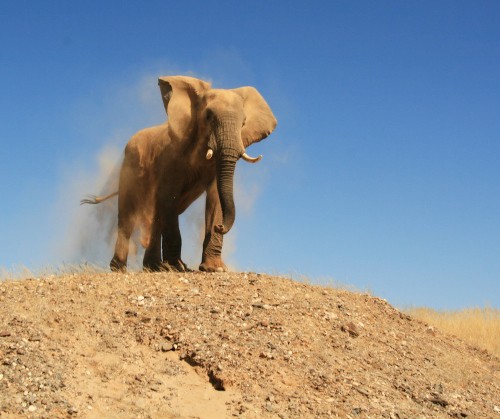
This image is posted on my flickr account.
We had a really long day, with an 11 hour game drive, but it was certainly worth it, considering the experience we had.
The next day we took it easier and arranged a trip to visit a Himba village.

After our stay at Sesfontein we moved on to Etosha. Etosha is just plain fantastic! I have never been through Etosha without a feeling that my stay was to short!
Our first to nights in the park were at Okaukuejo. Okaukuejo is the rest-camp within the park in the center. There are a further two rest-camps further east, namely Halali and Namutoni.
Okaukuejo is famous for it's waterhole. It is floodlit at night and both night and day the waterhole is interesting to watch.

Our full day at Okaukuejo was simply spent watching the waterhole. I ran around birding and trying to find birds for the guests to photograph. They got great images of Pygmy Falcons, that gave us great opportunities to really study them and compose great pictures. My lens was a little to short for great pics, but I had a go non the less.
From Okaukuejo we made our way accross the park. We stopped at Halali where we had a lunch stop and found some Owls to photograph with the help of the staff at Halali Rest-camp.

After lunch the game drive vehicles from Mushara Lodge came out to Halali as a special favor so that the guests could do the afternoon in open vehicles...better for photography than our mini vans.
Our last two night of the trip were spent at Mushara. We spent the full day doing game drives on the Eastern side of the park. We moved at a slow pace and spent a lot of time with any game we found, regardless of weather they were lions or springbok. It was a great way to finish off the trip.
The very last waterhole we visited was certainly one of the highlights of the whole tour, with over 50 elephants on a single waterhole in great afternoon light!
The next day was an early morning, long drive back to Windhoek for the guests flight home. It certainly could have been my favorite trip ever.
I would like to add a special thanks to Shem Compion from C4Images for using me to help on the trip, and to Martin Withers, the group leader from Hoskings Tours and a master wildlife/nature photographer. Of course, I would also like to thank the guests if any of them ever see this blog post. It was fantastic.

• Digg • Stumble • Technorati • Facebook • Reddit • Subscribe •
Sossusvlei
Sossusvlei is Namibia's premium travel destination. I have seen a number of articles about Sossusvlei and none that I have found over the Internet give very good information. I have been living here (at Sossusvlei Mountain Lodge) since the end of 2000 and I have done some 900 Sossusvlei excursions. I have, over the years, made a real effort to learn as much as possible about the area. Here's a little information:
Sossusvlei's location: Sossusvlei is found in Namibia. Namibia is an African country found on the west of Africa on the southern portion of the continent. Sossusvlei is in the south west of Namibia. Sossusvlei is reached by going through Sesriem (where the gate of the national park is) Sossusvlei is found in the Namib Naukluft Park. Sesriem is about 380 kilometers form Windhoek and Swakopmund.
How to get there: By road or flying in. By road (from Luderitz, Windhoek, and Swakopmund. For the most part the roads are all gravel. The roads are generally well maintained, but some sections may be bad at times. It is well worth your while asking about roads while traveling. They days on the road in Namibia can be long. You may choose not to hire a car, but rather to take a tour to Sossusvlei and let a guide drive you. This option lets you experience the area without the trouble of driving yourself. Of course, you can book with us, Frantic Naturalist.
Where to stay: There are a number of good places to stay. Having worked at Sossusvlei Mountain Lodge, I would certainly recommend it as perhaps the best lodge in Namibia. Not only is it a good place from which to visit Sossusvlei, but there is a lot to do on NamibRand Nature Reserve. There are a number of other upmarket lodges, such as Little Kulala, some cheaper lodges like Desert Homestead and Sossusvlei Lodge, and camping at Sesriem. Camping does allow you to go in an hour early and come out an hour late. This is great for photographers.
When to go: Summers can be really hot and winters cold. So the best time to visit Sossusvlei is in March/April/May and September/October. The rainy season is in the beginning of the year, but it is not usually much of a problem for visiting Sossusvlei. If there has been a lot of rain, it is good to spend a couple of days, in case the river flows. It is a very exciting time to be in the area.
Sossusvlei system: Sossusvlei is a pan in the middle of a desert. The Namib Desert is a coastal desert stretching up the western part of Namibia along the coast. In the southern part of the Namib is the Namib Sand Sea. The Namib Sand Sea is a huge, 34,000 square kilometer dune field or erg.
Sossusvlei is found in the middle of this sand sea. It is around 55 kilometers from the sea (the Atlantic,) and it is around 63 kilometers drive from Sesriem. There is no town or settlement or accommodation at Sossusvlei.
The pan of Sossusvlei is a flood pan of the Tsauchab River. The Tsauchab River flows from the Naukluft Mountains in the east down into the Namib Sand Sea. It initially creates a large open valley, before the dunes finally stop the river at Sossusvlei. There is no further surface flow from there on. If you want to get a good idea of how it looks, have a look at 'sossusvlei' on Google Earth.
Sossusvlei is most famous for it's dunes. The dunes are often referred to as the highest dunes in the world. There are no really good references to dune heights and so it is not accurate to claim that. They certainly are big. Most of the dunes in the valley reach up to about 220 meters from ground level. Those that go higher only do so because the ground level changes under them. What is amazing about the valley leading down to Sossusvlei is that these huge dunes, with beautiful red/orange colors, go from ground level up to huge heights, towering over this open valley.
Starting at Sesriem one first needs to get a permit to enter the park. This can take some time. You then need to show your permit at the inside gate before proceeding into the park. Soon a road turns off to your right. This goes to Elim dune. These dunes are part of the eastern margin dunes. They are characterized by vegetation and different ridges. This is a good area to find the Dune Lark, Namibia's only true endemic bird.
If you carry on without going in to Elim the road carries on westward towards Sossusvlei. Initially the dune valley is vary broad and so you only really see the dunes on the right hand side. As you travel past the park's airstrip, you will seed some red rock like stuff sticking out of the distant dunes. These are the so-called 'Petrified Dunes.' These are old remnants of dunes that have become a brittle sandstone.
Further along you will see the dunes change from the partly vegetated linear dunes into Star Dunes. It is clear to see that here the dunes are divided from one anther.
The Tsuachab river is on your right hand side at this point. As you carry on and get nearer the dunes you will see some 'fairy circles' on your right hand side. These barren patches in the grass are still a mystery. Some researchers believe they may be caused by tiny termites in the ground?
Further along you will be facing Dune 1. This huge dune will be in front of you before you turn down the hill to cross the Tsauchab river. The smaller Aub river is further to the South and floods out onto the plains about five kilometers further. After the Aub river has flooded out the valley narrows and the road takes you closer to the dunes on the left (south) of the valley.
Here there are some great photo opportunities. There are three huge dunes in a row before the only hill in the valley. Stop along the road at one or two of these dunes while the shadow is full in the early morning light to get the typical 'Sossusvlei' photo.
After the hill on the left you will soon reach Dune 45. Dune 45 has become the most well known dune in the area. There is a parking lot here. Most mornings the Overland Trucks stop here to walk up the dune. It can be crowded. I usually only like it to take my kids running in the dunes. They don't mind the crowd and Sossusvlei is a bit of a far drive for small children waiting to play in the sand!
If you carry on the remainder of the valley is lined with some amazing dunes. The whitish grey color in the valleys between the dunes on the way to Sossusvlei come from the river sand blown up between the dunes.
Soon a white clay pan stretches out where the river starts to flood out (when it reaches here - usually only a couple times a decade.)
The dunes start to block the river and a new area of Camel Thorn trees and !Nara bushes lead in the last five kilometers to Sossusvlei. This area must be traversed with a four wheel drive vehicle. If you don't have one, go in by foot or with a shuttle. If you walk, take enough water and watch the sun. When going in in winter, dress warm for the shuttles, they use open vehicles.
Around Sossusvlei there are a variety of attractions. There is the famous 'Big Daddy' or Crazy Dune. This 220 meter dune is reached by crossing Ostrich Vlei. Ask any local guide to show you. It is a serious dune and shouldn't be attempted unless you are very fit. Once on top you will have a great view over the dunes and over Deadvlei. The run down the dune, towards Deadvlei is one of the highlights.
I will talk about Deadvlei in more detail in a future blog. It can be reached more easily by parking at the parking area labeled 'Deadvlei Parking.'
Just a little beyond the Deadvlei parking area is Sossusvlei itself. You can cross over the cable and walk down to the pan. It is usually dry, but has flooded (1997, 2000, 2001 and 2006) from time to time. When flooded the pan attracts water birds as well as the normal desert animals like Oryx, Springbok, Black-backed Jackals and Springbok.
Walk Dune 22 (on the western side of the pan) to get a view over Sossusvlei and the area.
Sossusvlei is one of those places that will stick out in your mind for a long time. It has an unreal feeling when you area there. Truly an amazing place to visit. Share this post
• Digg • Stumble • Technorati • Facebook • Reddit • Subscribe •
Sossusvlei's location: Sossusvlei is found in Namibia. Namibia is an African country found on the west of Africa on the southern portion of the continent. Sossusvlei is in the south west of Namibia. Sossusvlei is reached by going through Sesriem (where the gate of the national park is) Sossusvlei is found in the Namib Naukluft Park. Sesriem is about 380 kilometers form Windhoek and Swakopmund.
How to get there: By road or flying in. By road (from Luderitz, Windhoek, and Swakopmund. For the most part the roads are all gravel. The roads are generally well maintained, but some sections may be bad at times. It is well worth your while asking about roads while traveling. They days on the road in Namibia can be long. You may choose not to hire a car, but rather to take a tour to Sossusvlei and let a guide drive you. This option lets you experience the area without the trouble of driving yourself. Of course, you can book with us, Frantic Naturalist.
Where to stay: There are a number of good places to stay. Having worked at Sossusvlei Mountain Lodge, I would certainly recommend it as perhaps the best lodge in Namibia. Not only is it a good place from which to visit Sossusvlei, but there is a lot to do on NamibRand Nature Reserve. There are a number of other upmarket lodges, such as Little Kulala, some cheaper lodges like Desert Homestead and Sossusvlei Lodge, and camping at Sesriem. Camping does allow you to go in an hour early and come out an hour late. This is great for photographers.
When to go: Summers can be really hot and winters cold. So the best time to visit Sossusvlei is in March/April/May and September/October. The rainy season is in the beginning of the year, but it is not usually much of a problem for visiting Sossusvlei. If there has been a lot of rain, it is good to spend a couple of days, in case the river flows. It is a very exciting time to be in the area.
Sossusvlei system: Sossusvlei is a pan in the middle of a desert. The Namib Desert is a coastal desert stretching up the western part of Namibia along the coast. In the southern part of the Namib is the Namib Sand Sea. The Namib Sand Sea is a huge, 34,000 square kilometer dune field or erg.
Sossusvlei is found in the middle of this sand sea. It is around 55 kilometers from the sea (the Atlantic,) and it is around 63 kilometers drive from Sesriem. There is no town or settlement or accommodation at Sossusvlei.
The pan of Sossusvlei is a flood pan of the Tsauchab River. The Tsauchab River flows from the Naukluft Mountains in the east down into the Namib Sand Sea. It initially creates a large open valley, before the dunes finally stop the river at Sossusvlei. There is no further surface flow from there on. If you want to get a good idea of how it looks, have a look at 'sossusvlei' on Google Earth.
Sossusvlei is most famous for it's dunes. The dunes are often referred to as the highest dunes in the world. There are no really good references to dune heights and so it is not accurate to claim that. They certainly are big. Most of the dunes in the valley reach up to about 220 meters from ground level. Those that go higher only do so because the ground level changes under them. What is amazing about the valley leading down to Sossusvlei is that these huge dunes, with beautiful red/orange colors, go from ground level up to huge heights, towering over this open valley.
Starting at Sesriem one first needs to get a permit to enter the park. This can take some time. You then need to show your permit at the inside gate before proceeding into the park. Soon a road turns off to your right. This goes to Elim dune. These dunes are part of the eastern margin dunes. They are characterized by vegetation and different ridges. This is a good area to find the Dune Lark, Namibia's only true endemic bird.
If you carry on without going in to Elim the road carries on westward towards Sossusvlei. Initially the dune valley is vary broad and so you only really see the dunes on the right hand side. As you travel past the park's airstrip, you will seed some red rock like stuff sticking out of the distant dunes. These are the so-called 'Petrified Dunes.' These are old remnants of dunes that have become a brittle sandstone.
Further along you will see the dunes change from the partly vegetated linear dunes into Star Dunes. It is clear to see that here the dunes are divided from one anther.
The Tsuachab river is on your right hand side at this point. As you carry on and get nearer the dunes you will see some 'fairy circles' on your right hand side. These barren patches in the grass are still a mystery. Some researchers believe they may be caused by tiny termites in the ground?
Further along you will be facing Dune 1. This huge dune will be in front of you before you turn down the hill to cross the Tsauchab river. The smaller Aub river is further to the South and floods out onto the plains about five kilometers further. After the Aub river has flooded out the valley narrows and the road takes you closer to the dunes on the left (south) of the valley.
Here there are some great photo opportunities. There are three huge dunes in a row before the only hill in the valley. Stop along the road at one or two of these dunes while the shadow is full in the early morning light to get the typical 'Sossusvlei' photo.
After the hill on the left you will soon reach Dune 45. Dune 45 has become the most well known dune in the area. There is a parking lot here. Most mornings the Overland Trucks stop here to walk up the dune. It can be crowded. I usually only like it to take my kids running in the dunes. They don't mind the crowd and Sossusvlei is a bit of a far drive for small children waiting to play in the sand!
If you carry on the remainder of the valley is lined with some amazing dunes. The whitish grey color in the valleys between the dunes on the way to Sossusvlei come from the river sand blown up between the dunes.
Soon a white clay pan stretches out where the river starts to flood out (when it reaches here - usually only a couple times a decade.)
The dunes start to block the river and a new area of Camel Thorn trees and !Nara bushes lead in the last five kilometers to Sossusvlei. This area must be traversed with a four wheel drive vehicle. If you don't have one, go in by foot or with a shuttle. If you walk, take enough water and watch the sun. When going in in winter, dress warm for the shuttles, they use open vehicles.
Around Sossusvlei there are a variety of attractions. There is the famous 'Big Daddy' or Crazy Dune. This 220 meter dune is reached by crossing Ostrich Vlei. Ask any local guide to show you. It is a serious dune and shouldn't be attempted unless you are very fit. Once on top you will have a great view over the dunes and over Deadvlei. The run down the dune, towards Deadvlei is one of the highlights.
I will talk about Deadvlei in more detail in a future blog. It can be reached more easily by parking at the parking area labeled 'Deadvlei Parking.'
Just a little beyond the Deadvlei parking area is Sossusvlei itself. You can cross over the cable and walk down to the pan. It is usually dry, but has flooded (1997, 2000, 2001 and 2006) from time to time. When flooded the pan attracts water birds as well as the normal desert animals like Oryx, Springbok, Black-backed Jackals and Springbok.
Walk Dune 22 (on the western side of the pan) to get a view over Sossusvlei and the area.
Sossusvlei is one of those places that will stick out in your mind for a long time. It has an unreal feeling when you area there. Truly an amazing place to visit. Share this post
• Digg • Stumble • Technorati • Facebook • Reddit • Subscribe •
Subscribe to:
Posts (Atom)
